





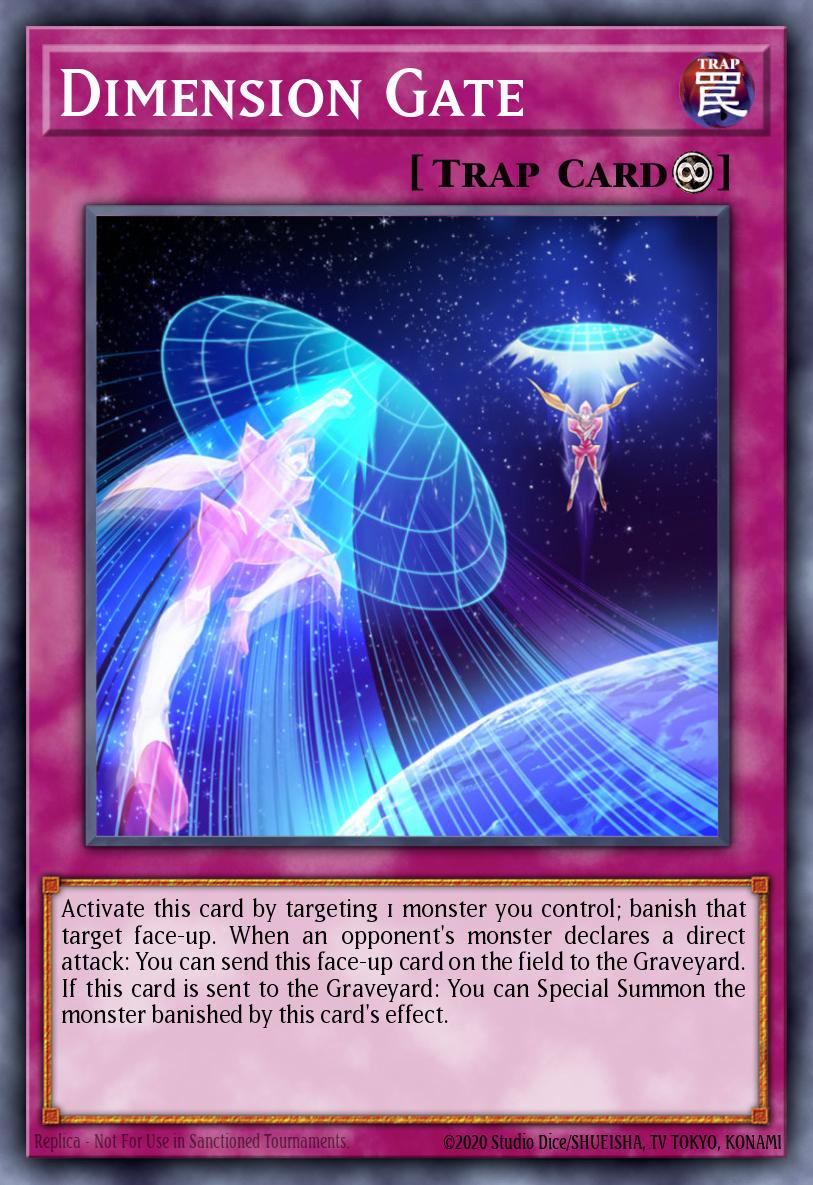

 Trap
 Continuous
Dimension Gate
View:
4001
Activate this card by targeting 1 monster you control; banish that target face-up. When an opponent's monster declares a direct attack: You can send this face-up card on the field to the Graveyard. If this card is sent to the Graveyard: You can Special Summon the monster banished by this card's effect.
Dimension Gate — Power Evaluation
Final Score: 46 ± 8 · Confidence: Medium
- Intrinsic: 45 · Deck: 47 · Meta: provisional
- Primary role: Recovery/Recursion · Secondary: Utility
Why it scores here
Dimension Gate is a self-banish-and-recur trap: it banishes one of your own face-up monsters, then, if it is sent to the Graveyard from a direct attack, it Special Summons that monster back. It does not negate the attack, and the card spends itself to do so, so it converts a monster into a saved, recurred body rather than into board or card advantage. The score is driven by recursion and cheap deck slots, not by any ATK or DEF, and the observed Timelord-heavy deck usage confirms the role is real without raising the score on its own.
Axis scores
| Axis | Score | Evidence |
|---|---|---|
| Accessibility | 40 | Needs to be set and activated, and needs a face-up monster of your own to target; the role is live in 4 of the sampled decks, but no starter or searched data exists (observed, deck sample). |
| Combo & Conversion | 35 | Text only: one banished monster comes back, with no extra body or board; no combo records exist to show a larger line (verified text, no combo data). |
| Resource Economy | 45 | The trap is spent and the monster returns, so the net is roughly a 1-for-1 that saves a body; no refuel or repeated advantage is described (verified text, inferred net). |
| Effect & Interaction | 20 | Its only interaction is recurring a monster after a direct attack is declared; it does not negate or stop the attack (verified text). |
| Material Utility | 10 | Trap card with no material body of its own; the monster it recurs is the same body it banished (verified text, inferred). |
| Resilience & Flexibility | 40 | Must stay face-up on the field to use its second effect, so backrow destruction or banish effects would shut it off; no interaction data for this card (inferred from text, no observed data). |
| Deck-Building Efficiency | 60 | Single trap slot, 3 copies legal with no banlist token, no garnets or locks in the text; the observed copies average 2.5 per deck, a low-cost slot (verified text, observed copies). |
Calculation
Weight profile: Primary Recovery/Recursion, no secondary blend; secondary role Utility recorded but not weighted. Intrinsic ≈ 45, Deck ≈ 47, Meta = provisional. Modifiers: none. Final formula: 0.40*Intrinsic + 0.60*Deck
Strengths
- Recurs one of your own monsters after it was banished, from a direct attack declaration
- Trap slot with no garnet or lock restrictions and legal at 3 copies in all listed formats
- Appears in 4 different archetype homes, with consistent Timelord partner pairing
Weaknesses
- Needs a face-up monster of your own to target before it does anything
- Does not negate the direct attack; it only saves a monster afterward
- Spends the trap itself, so it is a net -1 card in exchange for keeping one monster
- Second effect requires the card to stay face-up on the field
Counters / choke points
- Backrow destruction or removal of a face-up trap (inferred from the face-up requirement, no observed interaction data)
Best use
Recovery/Recursion. Decks: Timelord, D/D/D (D.D.), Gate Guardian.
Evidence & gaps
- Verified: Activation requires targeting one monster you control and banishing it face-up; On an opponent's direct attack declaration, the face-up card can be sent from the field to the Graveyard, and it then Special Summons the banished monster; The effect does not negate the attack
- Observed: Appears in 4 of 4 sampled decks across 4 archetype homes (Timelord x2, D/D/D, Gate Guardian); Averages 2.5 copies per deck (distribution 1 and 3), and runs in the main deck in all 4 decks; All 4 decks run the Timelord monsters, which appear as top partners
- Inferred: Primary role is Recovery/Recursion: it returns a banished monster rather than negating or removing an opponent card; Net card cost is roughly 1-for-1, since the trap is spent to keep the monster
- Data gaps: no combos supplied, so combo conversion is text-only inference no guides supplied no usage statistics (StatisticsCard) for this card, so archetype inclusion is inferred from the 4-deck sample only no banlist token; assumed 3 copies (unlimited) no as_starter or as_searched data, so the accessibility score is text-based